Workplace wellbeing covers every physical, psychological and organizational factor that allows employees to feel well in their work: health, safety, meaning, recognition, work-life balance and the quality of working relationships. It is not a perk program. Employers carry a duty of care for their people’s physical and mental health — formalized in France by the QVCT framework and article L4121-1 of the Labour Code, and internationally by ISO 45003, the standard for managing psychosocial risk at work.
The stakes are economic, not cosmetic: the World Health Organization estimates that depression and anxiety cost the global economy US$1 trillion per year in lost productivity.
The stakes show up in the accounts, not only in engagement surveys:
| Absenteeism | Stress and psychosocial disorders rank among the leading causes of long-term sick leave |
| Turnover | Lack of recognition and burnout drive people out — recruiting and training a replacement costs several months of salary |
| Productivity | Fatigue and cognitive overload erode focus, quality and safety — NASA measured a 34% performance gain after a single 26-minute nap |
| Employer brand | Candidates now judge concrete wellbeing commitments, not slogans |
| Duty of care | Employers must assess and prevent psychosocial risk — an explicit legal obligation in France (DUERP, art. L4121-1) and the core requirement of ISO 45003 internationally |
A credible workplace wellbeing program acts on six complementary levers:
Clarify priorities, stop chronic overload, protect the right to disconnect.
Regular feedback, real autonomy, recognition of the work done — the single biggest driver of engagement.
Ergonomics, acoustics, light, and break spaces that deserve the name.
Predictable hours, structured remote work, rest periods that are actually respected.
Regular assessment (risk register, wellbeing survey), manager training, listening channels.
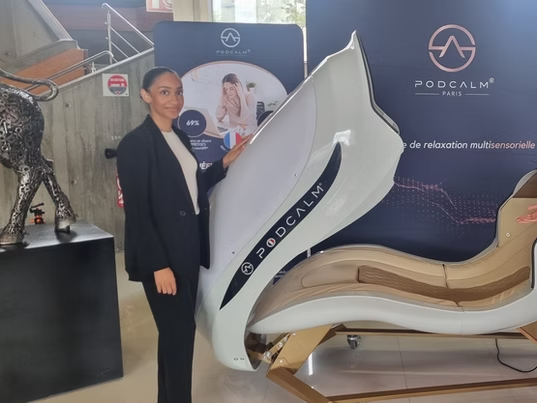
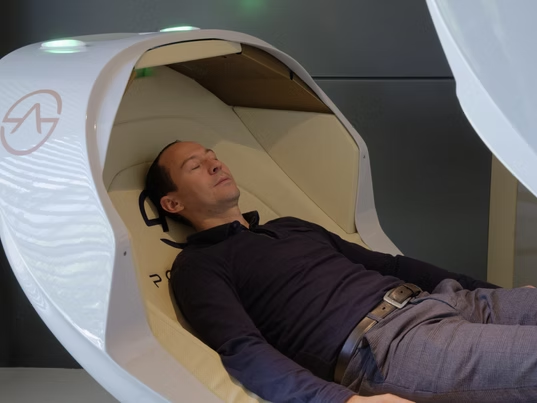
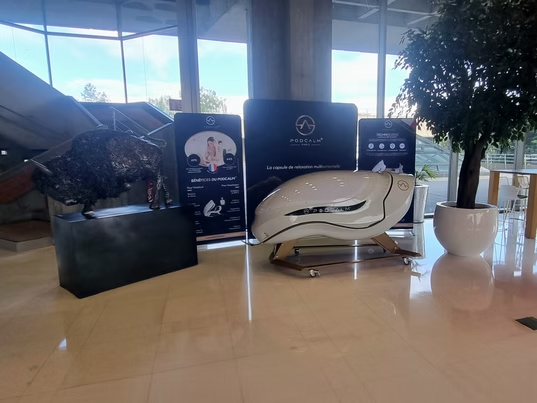
This is the lever most often forgotten: giving employees a real way to bring their stress level down during the working day. Micro-breaks, short naps, equipped recovery spaces. That is exactly the role of the PODCALM multisensory relaxation capsule: a 20-minute guided session equivalent to 2 hours of rest, with no supervision required — used by DERICHEBOURG, SNCF and E.Leclerc.
Where to start? Three levels of action, from the simplest to the most structural:
| Week 1 — measure | Run an anonymous employee wellbeing survey: perceived stress, workload, recognition, sleep |
| Month 1 — act visibly | Create a genuine recovery space (quiet room, relaxation capsule) and train managers to read the early warning signs |
| Quarter 1 — structure it | Embed wellbeing in the risk assessment and track board-level indicators: absenteeism, turnover, eNPS, recovery space usage |
To see a PODCALM capsule in real conditions: find where to try PODCALM near you
Every physical, psychological and organizational factor that allows employees to feel well in their work: health, safety, meaning, recognition, work-life balance and working relationships.
Wellness programs usually target individual health behaviors — gym access, nutrition, meditation apps. Wellbeing addresses the working conditions themselves: workload, management, environment and recovery. France formalized that shift in 2020 when QVCT replaced QVT in the national interprofessional agreement.
Employers have a duty of care for the physical and mental health of their staff. In France it is explicit — article L4121-1 of the Labour Code and mandatory psychosocial risk assessment in the DUERP. Internationally, ISO 45003 sets the reference framework for managing psychosocial risk at work.
Measure with an anonymous survey, act on organization and management, then equip: a recovery space with a solution such as the PODCALM capsule makes the commitment visible and measurable — a 20-minute session delivers recovery equivalent to 2 hours of rest.
Deliberately lowering physiological stress during the working day rather than after it: micro-breaks, short naps, breathing exercises or a guided multisensory session. NASA research shows a 26-minute nap improves performance by 34% and alertness by 54%.
Reference data and guidance on workplace wellbeing: